

JUBA, February 20, 2026
The government of South Sudan has approved a major $2 billion road construction and rehabilitation program backed by the country’s gold reserves, marking one of the largest infrastructure investments in recent years.
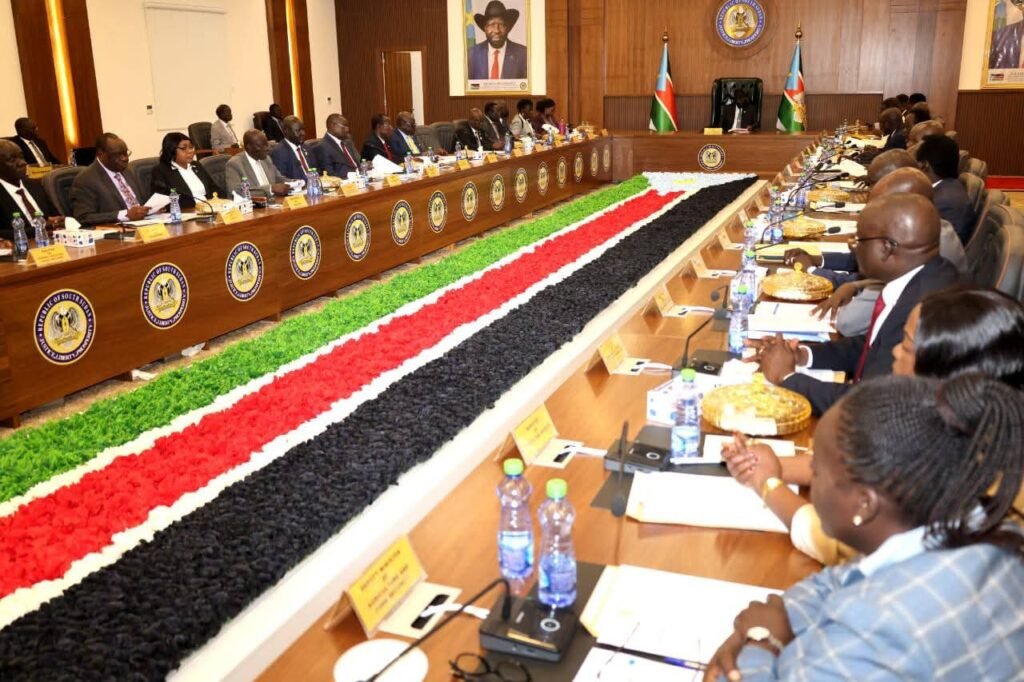
The decision was reached during a regular meeting of the Council of Ministers chaired by President Salva Kiir Mayardit. Officials described the initiative as a transformative step aimed at reshaping the nation’s transport network and accelerating economic growth.
Under the plan, the Cabinet granted a sovereign guarantee to Shamrock Global Group to upgrade and construct more than 1,031 kilometers of key national highways. Several priority routes will be paved to asphalt standard, including the Juba–Yei–Kaya corridor and the Yei–Faraksika–Maridi road, the Juba–Lobonok–Moli Junction stretch, as well as the Wau–Raja–Boro Medina road.
Information Minister Ateny Wek Ateny told reporters that the entire project is valued at $2 billion, with an estimated average cost of $2.3 million per kilometer. He emphasized that the investment reflects the government’s determination to modernize critical infrastructure and improve connectivity across the country.
The proposal was introduced by Mining Minister Lasuba Ludoru Wongo, who recommended leveraging the nation’s gold reserves as collateral to secure financing. According to officials, the approach is intended to capitalize on the country’s natural resources to fast-track long-delayed development priorities.
Minister Ateny further underscored the importance of peace and security in ensuring the success of such large-scale initiatives, noting that stability remains essential for infrastructure expansion and the country’s democratic transition.
Infrastructure ChallengesSouth Sudan’s road network remains among the least developed in the region, with only a small percentage of roads paved since independence in 2011.
Vast areas become difficult to access during the rainy season, interrupting trade, humanitarian operations, and delivery of essential services.
The situation deteriorated further following the civil war that erupted in 2013. Years of fighting damaged key roads and bridges, halted construction works, and redirected national resources toward security expenditures. The conflict also discouraged investment and slowed reconstruction efforts, leaving many communities isolated and transportation costs significantly high.
Officials say the newly endorsed project is intended to reverse these setbacks by restoring major transport corridors, improving year-round accessibility, and stimulating economic activity across the country.
According to government sources, details of the decision were shared on the official Facebook page of the Office of the President, highlighting the administration’s commitment to infrastructure development and national recovery.
The $2 billion roads initiative is being viewed as a cornerstone of South Sudan’s reconstruction strategy, aimed at rebuilding infrastructure weakened by years of conflict and laying a foundation for sustainable growth.
