


Authorities in South Sudan have launched a sweeping crackdown on former senior government officials, arresting or detaining several high-profile figures in what observers describe as one of the most significant political security operations in recent years.
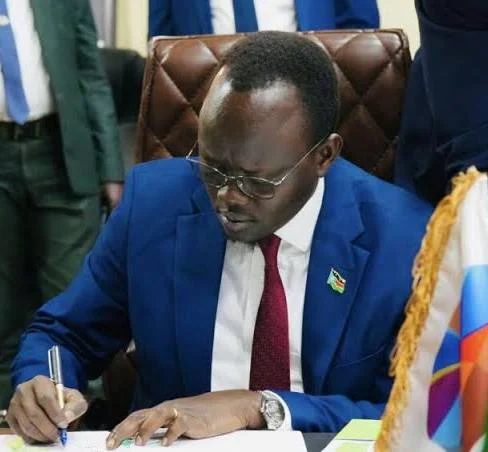
Among those detained is the immediate former Minister of Finance and Planning, Barnaba Bak Chol, who was arrested in the border town of Nimule near the Ugandan frontier. Security sources say he was intercepted while attempting to leave the country shortly after his dismissal from office. His removal came as part of a broader cabinet reshuffle ordered by President Salva Kiir Mayardit.
Reports indicate that security personnel recovered a significant amount of money in foreign and local currency at the time of Bak’s arrest. Images and videos circulating on social media appeared to show the former minister in custody under heavy guard, though authorities have not publicly confirmed the details surrounding the arrest or whether formal charges have been filed.
Wave of High-Profile Detentions
Bak’s detention is part of a broader sweep targeting former officials who once held key positions in South Sudan’s financial and security sectors.
Those reportedly arrested or placed under restriction include:
Marial Dongrin Ater, another former Minister of Finance and Planning, who was detained in Rumbek and later transferred to Juba for questioning.
Moses Makur Deng, former Governor of the Bank of South Sudan, who has reportedly been placed under house arrest.
Manasseh Machar Bol, a senior security official with previous links to strategic government institutions, taken into custody by national security agents.
Deng Lual Wol, former undersecretary in the Ministry of Petroleum, who was detained after appearing before security authorities for questioning.
The arrests have sparked speculation about whether the operation signals a genuine anti-corruption campaign or reflects internal political realignments within the ruling establishment.
Corruption Concerns and Economic Strain
South Sudan, the world’s youngest nation since gaining independence in 2011, has long faced accusations of widespread corruption, mismanagement of public funds, and lack of accountability within state institutions. International watchdog organizations have consistently ranked the country among those with the highest perceived levels of corruption globally.
The country’s fragile economy — heavily dependent on oil revenues — has been under severe strain due to fluctuating global oil prices, infrastructure challenges, and ongoing political tensions. Civil servants have frequently complained of delayed salaries, inflation has eroded purchasing power, and public services remain underdeveloped in many regions.
Analysts say the detention of former finance and banking officials could be linked to concerns over fiscal management, foreign exchange controls, and public revenue accountability. However, without official clarification, the precise motivations behind the arrests remain speculative.
Official Silence
Despite the scale of the crackdown, the government has yet to issue detailed public statements explaining the specific allegations against the detained officials. No formal charges have been publicly announced, and it remains unclear whether the individuals will face prosecution or internal administrative review.
Legal experts note that transparency in such high-profile cases will be critical to maintaining public trust and demonstrating commitment to the rule of law. Civil society groups have called for due process and urged authorities to clearly communicate the legal basis for the detentions.
For now, the reasons for the arrests remain unclear, leaving citizens and observers awaiting further explanation from the government about the scope and purpose of the mass arrests.
